
Wisen IT Solutions

PRECISE | DATA-DRIVEN | PYTHON-FIRST

Master ML Classification. Build Accurate Prediction Models with AI.

Learn classification where it is actually hard — imbalanced data, threshold selection, calibrated probabilities, and the metrics that reflect what a false negative really costs.

Explore Machine Learning Classification Course
Machine Learning Classification training with scikit-learn at Wisen IT Solutions, Chennai, India
Project-Ready Training

Classification Training for AI-Ready Data Science Careers

Machine Learning Classification Course at Wisen IT Solutions, Chennai, India, develops practical skills for the prediction problems businesses actually run — fraud, churn, risk and moderation, where the interesting class is rare. Learn stratified validation, linear and ensemble classifiers, imbalanced learning, threshold selection, probability calibration, tuning, interpretation and error analysis through project-focused, AI-Assisted Learning.

AI-Enabled Career-Focused Classification Course. Build Models That Survive Imbalance.

Wisen IT Solutions, Chennai, India
Call +91 900 31 31 555
  • Imbalanced Data Expertise
  • Metric Selection on Real Costs
  • Calibrated, Usable Probabilities
  • AI-Assisted Error Analysis
  • Project-Ready Classification Skills
  • Trusted by 30+ Corporate Clients

Think with AI. Don't Depend on AI.

Wisen IT Solutions, Chennai, India

Separate. Calibrate. Decide.

Machine Learning Classification Course for the AI-Era

Build practical classification skills for the AI-Era through hands-on training in problem framing and class balance, stratified splitting, linear classifiers, trees and boosting ensembles, kNN, naive Bayes and SVMs, imbalanced learning with resampling and class weights, evaluation metrics in depth, probability calibration, hyperparameter tuning, interpretation and error analysis, and a full classification project. Learn to choose a threshold rather than accept a default, develop project-ready, AI-ready ML skills, and open new career opportunities in data science.

Chapter 01

Framing a Classification Problem Topics

  • What Classification Predicts
  • Binary, Multiclass and Multilabel
  • Choosing the Positive Class
  • The Cost of a False Positive vs a False Negative
  • Defining Success With the Business
  • Class Balance and Base Rates
  • Why Accuracy Misleads
  • Establishing a Dummy Baseline
  • Environment and Dataset Setup
  • A First Classifier End to End

Chapter 01

Framing a Classification Problem Topics

  • What Classification Predicts
  • Binary, Multiclass and Multilabel
  • Choosing the Positive Class
  • The Cost of a False Positive vs a False Negative
  • Defining Success With the Business
  • Class Balance and Base Rates
  • Why Accuracy Misleads
  • Establishing a Dummy Baseline
  • Environment and Dataset Setup
  • A First Classifier End to End

Corporate classification training for data science teams at Wisen IT Solutions, Chennai, India

Moving Beyond
Traditional Training
with
AI-Enabled Learning.

AI-Ready Technology
Learning Lab

Moving Beyond
Traditional Training
with AI-Enabled Learning

For Organizations

Corporate Classification Training

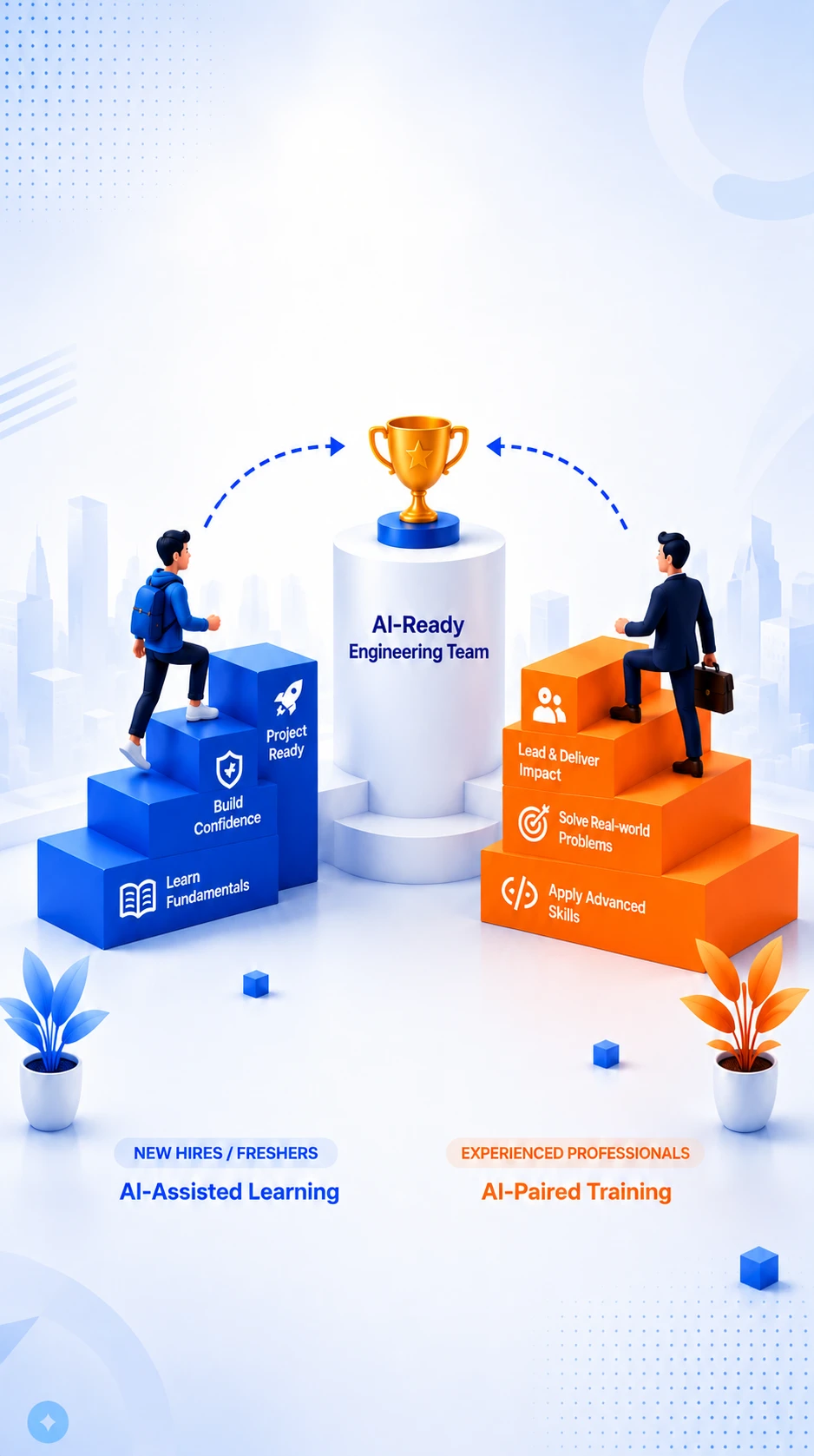
Build classification capability through AI-Enabled Learning across stratified validation, ensemble models, imbalanced learning, threshold selection, calibration and error analysis. Wisen’s Classification Training combines AI-Assisted Learning for the concepts with AI-Paired Training for practical modelling, so your team can defend a decision threshold to risk, compliance and the business rather than shipping a default of 0.5.

Industry-Relevant Classification Skills

Develop skills aligned with the fraud, churn, risk and moderation problems teams actually own.

AI-Enabled Learning

Use AI to accelerate error analysis without replacing statistical judgement.

Induction & Upskilling Programs

Structured paths for new hires and for analysts moving into predictive modelling.

Hands-On Modelling Workflows

Practise resampling, class weights, threshold tuning, calibration and slice analysis.

Customized Corporate Programs

Align the syllabus with your data, your imbalance ratios and your cost of error.

AI-Evaluated Skill Development

Evaluate practical progress through AI-assisted assessments that catch metric misuse.

Looking for a tailored classification program for your data science team? Let’s build the right learning journey for them.

Explore Corporate Training Page
Separate. Calibrate. Decide.

Skills You Gain from Classification Course

Develop practical classification capability, learning to frame a decision problem, handle the imbalance that makes it hard, choose a metric that reflects real cost, and set a threshold you can justify to the people who act on it.

  • Decision Framing

    Define the positive class and the cost of each kind of mistake before modelling.

  • Stratified Validation

    Split so that rare classes survive in every fold, and groups do not leak across.

  • Logistic Regression

    Fit, regularise and interpret the model that remains the right answer surprisingly often.

  • Trees and Forests

    Control depth and splitting, and read what a tree has actually learned.

  • Gradient Boosting

    Tune learning rate, depth and early stopping across the major boosting libraries.

  • Imbalanced Learning

    Apply class weights, resampling and SMOTE correctly — inside the fold, never outside.

  • Metrics in Depth

    Use precision, recall, F-beta, ROC AUC and average precision for what each is good at.

  • Confusion Matrix Reading

    Diagnose a model from its errors rather than from a single headline number.

  • Threshold Selection

    Pick an operating point from a precision-recall curve and the business cost.

  • Probability Calibration

    Make predicted probabilities mean what they claim, with Platt or isotonic scaling.

  • Hyperparameter Tuning

    Search with custom scorers without leaking the test set into the decision.

  • Model Interpretation

    Explain a classification with permutation importance, PDP and SHAP.

  • Error and Slice Analysis

    Inspect misclassified cases and check performance per segment.

  • AI-Assisted Error Analysis

    Use AI to accelerate failure investigation while validating every claim against your results.

  • Fairness Checks

    Test whether the model performs differently across groups, and report it.

Career Transformation Starts Here!

After completing the training, participants can build a classifier for an imbalanced, real-world problem, defend its metric and threshold, calibrate its probabilities, and explain exactly which cases it gets wrong.

91-900 31 31 555
How the verification works

How you verify your Machine Learning Classification skills independently

Most training providers set their own test and mark their own paper. We do not. At the end of each stage of the Machine Learning Classification Training you check your own readiness using your own ChatGPT, Claude, Gemini or other AI account. Wisen does not write the questions, does not see your answers, and does not record your score.

The reasoning is straightforward. A score we control proves very little — to an employer, or to you. A score produced by a tool we have no influence over is worth something. You ask the AI to test you on Machine Learning Classification, it decides what to ask, and the result belongs to you alone.

Seventy per cent is the mark we treat as ready. Score seventy or above and you move on to the next stage. Score below it and we work through the gap with you: identify what was missed, teach it again, practise it, then go back to the AI and check. You repeat that loop as many times as it takes.

In short

  • You use your own AI account, not one of ours.
  • We do not write the questions and cannot influence them.
  • Your score stays private — we never see it.
  • Below seventy per cent, we work through the gap with you and you verify again.
Placement Assistance

Career Support You Can Count On

Classification training aimed at the problems that are actually imbalanced. There is no job guarantee — there is a curriculum built on the cases that break naive models.

  1. 01

    Gain 2+ Years of Professional Knowledge

    Choosing a threshold, reading a precision-recall curve and explaining why accuracy is the wrong metric are two-year-level conversations. You practise all three.

  2. 02

    Resume / Biodata Support

    Get expert guidance to build a strong, professional resume that highlights your skills, projects and achievements.

  3. 03

    Portfolio Development

    Build real-world projects and a strong portfolio that demonstrates your practical skills to potential employers.

  4. 04

    Interview Preparation

    You will be given a fraud-shaped problem where the positive class is one per cent. We rehearse the metric argument and the resampling one.

  5. 05

    Job Search Guidance

    Classification underpins risk, fraud, churn and moderation roles. We help you identify which of those hire from your background and how to approach them.

  6. 06

    Placement Assistance

    We assist you in identifying relevant opportunities and connecting with potential employers.

  7. 07

    Independent AI Verification Checkpoint

    Your learning, projects and skills are verified by our Independent AI Verification System to ensure objective and unbiased evaluation.

  8. 08

    Future-Ready Knowledge

    Boosting libraries change; calibration, thresholding and cost-sensitive evaluation do not. Learn those and the next algorithm is a drop-in.

Our Commitment

Employment is not guaranteed here. Your result depends on your practice, your assessments and your interviews. We stay in your corner throughout.

Learn. Practice. Master Classification

Classification Training Course Materials

Classification Course learning materials with notes, lab activities and modelling exercises

The learning materials for this Classification Course are developed from 27+ years of Python and data training experience, refined across classroom batches, corporate Machine Learning Training programs, learner questions, lab reviews, and models built for real client projects.

Every chapter, notebook, lab activity and exercise in the Classification Online Course is built on genuinely imbalanced data — a fraud set where the positive class is under one per cent, a churn set where the obvious feature is recorded after the customer left — so the metric argument and the threshold argument are real ones.

What You'll Receive

Classification Learning Notes

Structured explanations of metrics, imbalance handling and calibration, written for study after each session.

Guided Lab Activities

Walkthrough labs that take one imbalanced dataset from baseline to a defended operating point.

Hands-on Exercises

Independent tasks on resampling, threshold tuning, calibration and slice analysis.

Practice Datasets

Fraud, churn and risk-shaped data where accuracy is actively misleading.

Progressive Learning Path

Topics sequenced from framing to deployment, so each session builds on the one before it.

Revision and Reference Sheets

Quick reference for metric formulas, averaging modes and resampler options.

What Makes Our Classification Materials Different?

27+ Years of Experience

Written by trainers who taught statistical modelling long before ML was a job title.

Human-Authored Content

Created and maintained by practising trainers, not assembled from generated text.

Original Learning Materials

Not copied from library documentation, books, or generic online ML tutorials.

Practice First

Every concept arrives with a dataset to model and a threshold to defend.

Refreshed for scikit-learn 1.x

Updated as the library evolves, covering current APIs and the modern boosting libraries.

AI-Assisted Quality Review

AI supports grammar, readability and presentation; the teaching content stays human.

Our Commitment

Our published curriculum is the evidence of our training.

The classification topics listed on this website reflect the actual learning journey delivered in our live instructor-led online sessions. We follow the published sequence and enrich it with extra imbalance case studies, threshold arguments and error post-mortems whenever they help the batch. Whether you join a Machine Learning Training in Chennai batch or attend from elsewhere, the published order is what gets taught.

Experience DrivenPractice FocusedResults Oriented
Predict. Review. Become Decision-Ready.

Classification Course Evaluation

Classification Training is evaluated twice over, independently. An experienced trainer assesses how you reason about cost and evidence, and an independent AI evaluation reviews the code you write, so you learn where your methodology is wrong as well as where your syntax is.

Classification is unusually easy to fake: on a dataset with one per cent positives, predicting "no" every time scores ninety-nine per cent accuracy. This course puts both evaluations to work on exactly those failures.

Human Evaluation

Our experienced trainers evaluate your ability to:

Cost Reasoning

State what a false positive and a false negative each cost, before modelling.

Metric Justification

Defend a metric choice rather than reporting whichever looks best.

Imbalance Handling

Apply weights or resampling correctly, and only inside the training fold.

Threshold Selection

Choose an operating point from evidence and explain the trade-off it makes.

Calibration Judgement

Recognise when a probability needs to be trustworthy, not just ranked.

Confusion Matrix Reading

Diagnose a model from its errors, per class and per segment.

Error Analysis

Inspect misclassifications and form a hypothesis about the cause.

Fairness Awareness

Check and report performance differences across groups.

Communication

Explain a classification decision to the person who has to act on it.

Independent AI Evaluation

Our independent AI evaluation reviews your classification code to assess:

Concept Application

Verify correct use of estimators, scorers and resampling pipelines.

Methodological Logic

Analyse whether the experiment supports the conclusion drawn.

scikit-learn Practices

Evaluate adherence to current conventions taught in the course.

Code Quality

Review readability, reproducibility and random-state handling.

Silent Errors

Identify resampling before splitting, leaked features and unstratified folds.

Efficiency

Flag oversized searches and needless refits.

Best Practices

Recommend improvements based on modern classification standards.

Project Readiness

Evaluate whether the notebook would survive a peer review.

Why Dual Evaluation?

Human trainers evaluate how you reason about cost and defend your operating point.

AI independently reviews the code for leakage, resampling errors and reproducibility.

Together they separate a high score from a model that will actually be useful.

Learning Outcome

By combining Human Evaluation with Independent AI Evaluation across our Machine Learning Training in Chennai and online, you will:

  • Choose a metric that reflects the real cost of being wrong
  • Handle imbalance without leaking synthetic data into validation
  • Set and defend a decision threshold
  • Deliver probabilities that can be trusted, not just ranked
  • Become project-ready for risk, fraud and churn modelling roles
AI-Assisted Classification Learning

Classification Course Duration & Batch Timings

Machine Learning Training in Chennai and online is delivered in live batches with two pace options, so the schedule bends around your commitments instead of competing with them.

Total Learning Hours

50 - 55 Hours

Instructor-led concept sessionsImbalance and resampling labsMetric, threshold and calibration labsEnd-to-end classification project

Normal Track

2.5 Hours / Session

A balanced rhythm that leaves time to rerun every experiment between sessions.

  • Working Professionals
  • Data Analysts Upskilling
  • Aspiring Data Scientists
  • Weekend Batches

Fast Track

5 Hours / Session

A concentrated schedule for learners who want the Classification Online Course finished sooner.

  • Full-time Learners
  • Job Seekers
  • Fresh Graduates
  • Career Switchers

What's Included?

Live Instructor-Led Training

Concept Deep Dives

Hands-on Modelling

Imbalance Lab Activities

Threshold Tuning Sessions

AI-Assisted Learning

Independent Code Evaluation

Doubt Clarification

ML Project Guidance

Same Curriculum |
Same Labs |
Same Evaluation |
Same Learning Outcome

The Classification Course content is identical on both tracks — the course you join in Chennai or online differs only in how quickly the sessions arrive.

Live online, worldwide

Join Machine Learning Classification Training from anywhere in the world

Every session is taught live by a practising engineer — never a pre-recorded video. Batches run to Indian Standard Time, and the timing is adjusted to suit your time zone wherever you are.

  • Live, not recorded

    You write code during the session, ask questions as they come up, and have that code reviewed.

  • Your time zone, any country

    Weekday and weekend slots in IST. If none of them suit where you live, we schedule a batch that does.

  • Pay from outside India

    International debit and credit cards, PayPal and direct bank transfer are all accepted.

Ask for a batch timing on your own clock
Balanced Learning. Imbalanced Data. Honest Results.

Lecture-Practical Ratio

A metric argument only lands once a useless model has scored ninety-nine per cent. This Classification Course therefore runs on a 40:60 Lecture-Practical Ratio, so every concept is immediately tested against data where the default choices fail.

Across the Classification Training you resample, tune, calibrate and diagnose yourself. Nothing in the course is left as something you only watched someone else type.

40%Theory

Understand what each metric rewards and what it hides.

  • Decision boundaries and separability
  • Why accuracy fails under imbalance
  • Precision-recall trade-offs
  • What ROC AUC ignores
  • Calibration versus ranking
  • Bias and fairness in classification
40:60Practice-Weighted Learning

60%Practical

Apply every concept to imbalanced data in the same session.

  • Live model fitting demonstrations
  • Resampling and class-weight labs
  • Metric comparison exercises
  • Threshold selection practice
  • Calibration curve walkthroughs
  • Confusion matrix and slice analysis
  • AI-assisted error investigation

Why a 40:60 Split Works for Classification

Understand the Trade-off

Learn what recall costs in precision before you are asked to choose.

Practise Immediately

Each concept is applied to imbalanced data in class.

Get Fooled Safely

A ninety-nine per cent useless model is met in the lab, not in a review.

Analyse Errors

Build the habit of inspecting the confusion matrix, not the headline score.

Finish Project-Ready

Leave able to deliver and defend a classifier end to end.

Our Learning Philosophy

Every classification concept is followed by a threshold you have to defend.Wisen IT Solutions, Chennai runs Machine Learning Training in Chennai and online on the belief that classification is learned by arguing about cost, not by maximising accuracy.

Fundamentals First. Then the Hard Cases.

Classification Course Prerequisites

This Classification Course assumes working Python, comfort with pandas, and the modelling fundamentals — pipelines, cross-validation and leakage awareness. If you have those, this course goes straight to the problems that make classification genuinely difficult.

The Classification Training is delivered live online, so the Machine Learning Training in Chennai batch and the online batch start from exactly the same imbalanced dataset.

Working Python and pandas

  • Functions, modules and virtual environments
  • Loading and reshaping data with pandas
  • Comfort with Jupyter notebooks
  • Reading a traceback and fixing the cause

Modelling Fundamentals

  • scikit-learn pipelines and transformers
  • Train, validation and test splitting
  • Cross-validation and why it exists
  • An awareness of data leakage

Setup For Modelling

  • A machine with 8 GB RAM and a stable connection
  • Python 3.x — installation guidance provided
  • scikit-learn, pandas and boosting libraries walkthrough included
  • Imbalanced practice datasets supplied by us

Who Can Join?

Data Analysts & Scientists

Python Developers

Risk & Fraud Analysts

Anyone who has finished our Machine Learning Fundamentals course

New To Machine Learning?

If pipelines and cross-validation are unfamiliar, start with our Machine Learning Fundamentals Course first. We will tell you honestly which of the two suits you rather than enrolling you in the harder one — this course moves quickly through the basics because it assumes you already have them.

All you need is working Python, the modelling fundamentals and a problem where one class is rare.

We’ll take care of the rest!
Every Model. Every Metric.

Classification Course Tools & Technologies

This Classification Course works through the model families and the evaluation machinery in depth: the classifiers, the resamplers, the scorers, the calibration wrappers and the inspection tools most tutorials never open.

The Classification Training works on data where the default settings actively mislead, which is what makes it an advanced course. Training in Chennai and the online batches run identical labs.

Linear & Probabilistic

LogisticRegression

L1 & L2 Regularisation

LDA & QDA

Naive Bayes

SGDClassifier

Trees & Ensembles

DecisionTreeClassifier

RandomForest & ExtraTrees

HistGradientBoosting

XGBoost & LightGBM

CatBoost

Voting & Stacking

Imbalance & Calibration

class_weight

SMOTE & Resamplers

Threshold Moving

CalibratedClassifierCV

Calibration Curves

Evaluation & Inspection

Confusion Matrix

classification_report

ROC & PR Curves

Permutation Importance

SHAP & PDP

Search with Custom Scorers

Learning Outcome

By the end of this Classification Course you can build a classifier for a one-per-cent positive class and defend every choice behind it — the difference an advanced classification course is meant to make.

Handle Imbalance

Choose the Metric

Set the Threshold

Calibrate Probabilities

Official references

Check what we teach against the scikit-learn documentation

Every metric the course asks you to justify — precision, recall, ROC AUC, average precision — is defined in the library’s scoring reference, which is linked here.

Got Questions - Quick Answers

Classification Training Frequently Asked Questions

27+
Years of Experience
17,700+
Professionals Empowered
2,700+
Happy Learners Every Year
30+
Corporate Clients

Corporate Training Clients

A Trusted Training Institute Upskilling Teams at Leading Companies Worldwide

A Wisen IT Solutions Python training advisor pointing towards the enquiry number

Build Future-Ready Skills. Gain Project-Ready Experience.
Succeed in AI-Transformed Careers.

The software industry is evolving with AI—not disappearing. Wisen's AI-Enabled Learning helps you master modern technologies, build strong engineering fundamentals, and collaborate effectively with AI tools like ChatGPT and Claude. Develop the practical skills, critical thinking, and real-world experience needed to build software with confidence and remain valuable throughout your career.

Talk to our AI Learning Advisor

+91 900 31 31 555